
Sichnews.com – Online news travels quickly in Malaysia. From breaking political developments to business announcements and viral social media posts, readers can access information within seconds. However, not every headline, screenshot, or forwarded message tells the complete story.
Knowing how to verify online news can help readers distinguish reliable reporting from misleading claims. Here are practical steps to take before believing or sharing a news story.
Why News Verification Matters
False or misleading information can spread when people share content without checking its source. An old photograph may be presented as a recent event, a headline may exaggerate what an article actually says, or an unverified claim may circulate as though it were confirmed.
Checking information before sharing it helps readers make better-informed decisions and reduces the risk of spreading inaccurate claims.
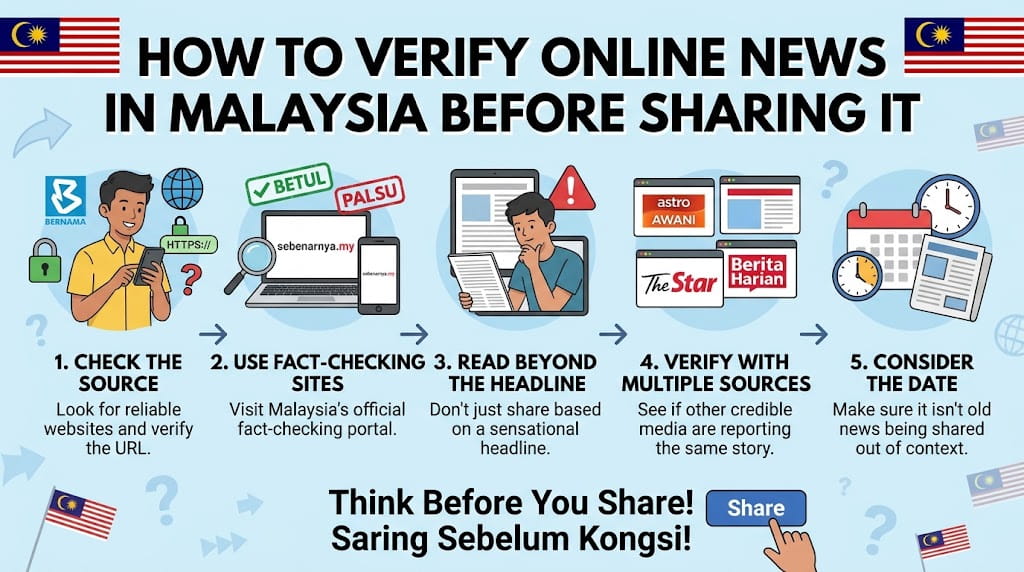
1. Check the Original Source
Start by identifying where the information first appeared. Look for the original article, official announcement, full interview, research paper, or public statement.
If a social media post refers to a news report, open the report rather than relying only on the post’s caption. Read beyond the headline to understand the context.
For government announcements or public policy updates, look for relevant official sources. For company news, check the company’s official statement or regulatory announcement when available.
2. Check the Publication Date
An accurate report can still be misleading if it is shared without its original date.
Old articles and photographs sometimes resurface during new developments, creating the impression that an earlier event has just happened. Check when the content was published and whether the information has since been updated.
For developing stories, look for the latest available report and note whether important details remain unconfirmed.
3. Compare Reports From Multiple Sources
When a story is significant, check whether other established news organisations are reporting the same key facts.
Compare the names, dates, locations, figures, and statements in each report. Different outlets may emphasise different aspects of an event, so focus on the facts that can be independently confirmed.
Several websites repeating the same unverified social media post do not necessarily provide independent confirmation. Look for reporting that identifies its own sources or provides original evidence.
4. Read Beyond the Headline
Headlines are designed to summarise a story, but short wording can sometimes leave out important qualifications.
Read the article to determine what actually happened, who was involved, when it occurred, and what evidence supports the main claim.
Pay attention to words such as “alleged,” “reportedly,” and “according to.” These terms may indicate that a claim has not been independently established.
If the headline makes a stronger claim than the article supports, avoid repeating the headline as a confirmed fact.
5. Examine Images and Videos Carefully
Photographs and videos can provide useful evidence, but they may be old, edited, taken out of context, or generated using artificial intelligence.
When an image seems suspicious, use a reverse image search to see whether it appeared online earlier. Look for the original upload, the photographer’s description, and other reports showing the same event.
For videos, check the full recording when available instead of relying on a short clip. A brief excerpt may omit the context needed to understand what happened.
Visual clues alone are not always sufficient to prove that an image is genuine or false. Seek additional evidence before reaching a conclusion.
6. Be Careful With Viral Messages
Forwarded messages on messaging apps and social platforms can make unverified claims appear credible simply because many people have shared them.
Be cautious when a message uses alarming language, promises extraordinary benefits, demands immediate action, or asks readers to forward it widely without providing verifiable evidence.
For claims involving emergencies, public safety, financial matters, or government services, look for relevant official announcements and credible reporting.
Avoid sharing personal information or clicking unfamiliar links simply because a message appears to come from a trusted contact.
7. Understand the Difference Between News, Opinion, and Advertising
Not every article has the same purpose.
News reporting generally aims to describe events and support factual claims with evidence. Opinion articles express a viewpoint or interpretation. Sponsored content and advertising promote a product, service, or organisation.
Check the article label, byline, publication details, and any sponsorship disclosure. Understanding the format helps readers evaluate the information in the right context.
A Simple Checklist Before Sharing News
Before forwarding or posting a story, ask yourself:
- Is the original source identifiable?
- Is the publication date relevant to the event?
- Can the main claims be independently confirmed?
- Does the full article support the headline?
- Are images and videos presented in their proper context?
- Is the content clearly identified as news, opinion, or sponsored material?
If important details remain uncertain, pause before sharing the story.
Stay Informed With Reliable Information
Keeping up with Malaysia news and global current affairs requires more than reading headlines. Checking sources, dates, evidence, and context can help readers understand developing stories and avoid spreading misleading information.
The next time a dramatic claim appears in your feed, take a moment to verify it before passing it on. A few careful checks can make a meaningful difference in the quality of information shared online.
SichNews Malaysia aims to help readers follow important developments through clear, accessible coverage of Malaysian news, business, technology, entertainment, sports, and global affairs.